Complaint management for online shops: de-escalation in 5 steps
Published on October 27, 2026
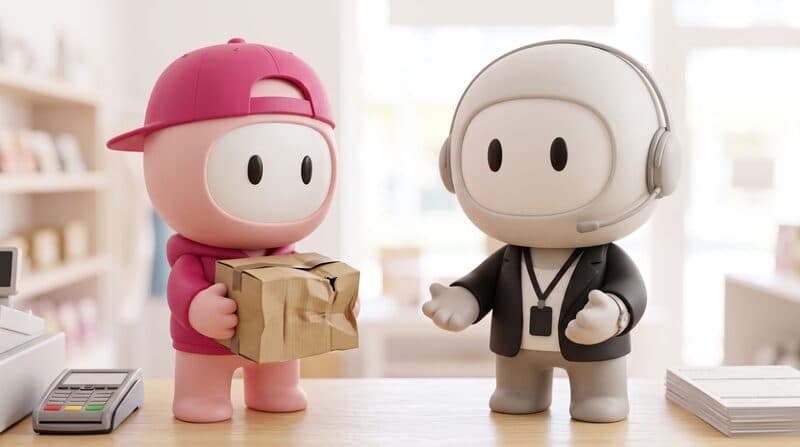
The email arrives on Sunday evening, subject line in capitals: “OUTRAGEOUS”. Below it: “I ordered two weeks ago, the parcel was supposedly delivered, I received NOTHING, and nobody replied to my first email. If I don't have my money by Tuesday there will be a review and a report to consumer protection.”
The first reaction is the same for almost everyone: anger. The tone is unfair, the carrier lost the parcel, and the first email landed in spam. None of that helps you now. What helps is understanding what this email actually says. Not “I hate you”, but “I paid money, received nothing and nobody cares”. That is a legitimate question in an illegitimate tone.
In Germany, complaints are the most common reason for contacting customer service at all. According to the Kundenservice Barometer 2024 by Armonia, complaints were the reason for contacting customer service in 41 percent of cases. This article shows in five steps how to de-escalate such an email, which phrases make it worse and where the line is beyond which no process helps, only a person.
Why customers escalate
A complaint rarely escalates because of the mistake itself. A lost parcel is annoying, but everyone knows it happens. It escalates because of what comes afterwards, or doesn't.
The typical triggers:
- Silence. The first email wasn't answered. From the customer's perspective that means: nobody cares. The Kundenservice Barometer 2024 found that 40 percent of respondents had to make contact more than once about the same request. The second email is almost always louder than the first.
- A reply without a solution. “We're looking into it” without a date is, for the customer, the same as silence, only politer.
- An explanation instead of a solution. “The carrier marked the parcel as delivered, we have no influence on that.” The customer didn't order from the carrier.
- The feeling of having to fight. Someone who believes they only get results by threatening, threatens. The review and consumer protection aren't malice, they are an attempt to be taken seriously.
What is at stake is shown by Zendesk CX Trends 2025: 63 percent of surveyed consumers are willing to switch to a competitor after a single bad experience. A badly handled complaint is that experience. A well-handled one is often the opposite.
Step 1: Read first, then check the facts, only then reply
The most common mistake is replying immediately. Either too sharply, because the tone got to you, or too softly, because you want the thing off your desk. Both go wrong.
Read the email twice. The first time you register the tone and set it aside. The second time you look for the facts: order number, what happened, what the customer wants, since when this has been going on. Then you check those facts yourself before you write a word. What does the shipment status really say? Does the first email exist, and why wasn't it answered? Has the customer complained before?
Only with those answers can you write an email that doesn't have to be corrected two hours later. Correcting your own reply is, with an angry customer, the second mistake after the first.
Step 2: Confirm the problem in the customer's words
The first sentence of your reply decides whether the customer keeps reading or is already typing the review. It has to show that you understood what this is about. Not in general, but specifically.
Not: “Thank you for your message. We regret any inconvenience caused.”
But: “You paid two weeks ago, the carrier says the parcel was delivered, nothing arrived at your place, and you got no reply to your first email. That's too much at once, and I'm sorry.”
The second sentence is an apology, but one for what actually happened. Not for “inconvenience”, but for the fact that nobody replied. Customers recognise the difference between an apology and a stock phrase instantly.
What doesn't belong in this step: an explanation. Why the email was in spam, why the carrier scanned wrongly. That comes later, if at all. Whoever explains first is defending. Whoever confirms first is listening.
Step 3: Say what you are doing now, and by when
After the confirmation, the customer wants to know one thing: what happens now. Not “we'll take care of it”, but a concrete step with a date.
“I've just opened an investigation with the carrier. At the same time I'm sending you the replacement today, the tracking number will come in a separate email. You don't have to wait until the investigation is complete. If the replacement parcel hasn't arrived by Thursday, reply to this email and I'll refund the amount immediately.”
Three things make this paragraph work:
- A step that has already happened. “I've opened”, not “I will open”.
- A solution that doesn't depend on the customer. They don't have to prove anything, fill in anything, wait for anything.
- A date and a plan B. The customer knows when to expect what, and what happens if it doesn't work.
If you don't know the solution yet because you first have to talk to the warehouse, then the concrete step is the conversation with the warehouse, and the date is when you'll get back to them. That is perfectly fine. What matters is that from now on the customer is no longer waiting for something undefined. How fast this first reply has to come is in Response time in customer service: what customers expect, what is realistic.
Step 4: Don't answer the threat
The email from the start contains a threat: a review, consumer protection. Most merchants react to it, either defensively (“We would like to point out that …”) or submissively (“Please refrain from leaving a review …”). Both make the threat the topic.
Ignore it. Not demonstratively, but simply by replying to the problem and not to the announcement. A customer whose problem is solved very rarely writes the threatened review. And if they do, it's one that says it turned out fine in the end. That is not theory: according to a survey by Trusted Shops and YouGov (2021), 65 percent of respondents trust a shop more when the operator responds to comments, and 58 percent would rather buy from a seller that has both positive and negative reviews.
The moment between complaint and review is where you can move the most. How to recognise it before it's over is in Preventing negative reviews: the support moment before.
One exception: when an email becomes abusive, personal, with threats that go beyond a review, it is no longer a complaint. Then you reply once, factually, set a boundary, and stop having the case handled by someone who takes it to heart.
Step 5: Follow up before the customer has to
The case isn't closed when the reply goes out. It's closed when the customer has what you promised, and knows it.
If you sent a replacement, write one line on the day of delivery: “According to the carrier, the replacement parcel arrived today. If not, let me know.” If you issued a refund, write when it went out. If the investigation has a result, share it, even if the customer has long had the replacement.
This one extra email is the difference between “problem solved” and “problem solved, and I'd order there again”. It costs thirty seconds. It is also the moment when you may say one sentence about a review, if you want to, because now the customer has a reason to write a good one.
The phrases that make it worse
A few phrases keep appearing in complaint replies and act like fuel on the fire every time:
- “As you can see in our terms and conditions …” The customer didn't ask about the terms. They asked whether anyone is taking care of this.
- “Unfortunately this is not our fault.” Even if true, the customer doesn't care, and it's the first thing they will quote.
- “We ask for your understanding that …” They don't have it, otherwise they wouldn't have written.
- “We did not receive your first email.” Possibly true, but sounds like an accusation. Better: “Your first email got lost on our side, that shouldn't have happened.”
- “As an exception and as a gesture of goodwill …” Whoever announces goodwill wants gratitude. Give the solution without labelling it.
And the most important one: exclamation marks. None belongs in a complaint reply.
Where automation helps and where it has to stop
Complaints are the area where most merchants are rightly sceptical about automation. A standard reply to an angry email is what created the anger in the first place.
Still, a system can do two things here. First: recognise the complaint as such, by wording, tone, history, and sort it to the top instead of leaving it in arrival order. Second: assemble the facts for step 1, order, shipment status, earlier emails, so the person replying doesn't spend ten minutes searching first.
This is how it works at Humane: the agent recognises angry customers by word choice and context and treats these emails differently from a normal delivery question. It prepares a draft reply that contains the order data and the real shipment status and follows the sequence above, confirm first, then the concrete step. That draft does not go out automatically. It waits for approval, and depending on the settings the case goes straight to a person. Whatever the merchant changes in the draft becomes a rule for the next similar case.
The line is clear: a customer writing for the second time, a goodwill decision outside the stored rules, an email with a legal undertone. Those are cases for you. An agent that answers them anyway doesn't save you time, it costs you the customer. Which goodwill rules you should set in the first place is in Right of withdrawal vs. goodwill: what you must do and what you can do.
In short
A complaint escalates because of silence, not because of the mistake. Read the email twice and check the facts before you reply. Confirm the problem in the customer's words and apologise for what really happened. Name the step you have already taken, and a date. Don't answer the threat, answer the problem. And follow up before the customer has to ask. Most complaints then end not with a review but with an order. The overview of all support topics is in the guide Customer service for online shops.
If you want to see how angry emails in your inbox are recognised and presented with the facts ready: try 100 customer requests for free, no credit card, and complaints always stay drafts until you approve them.